
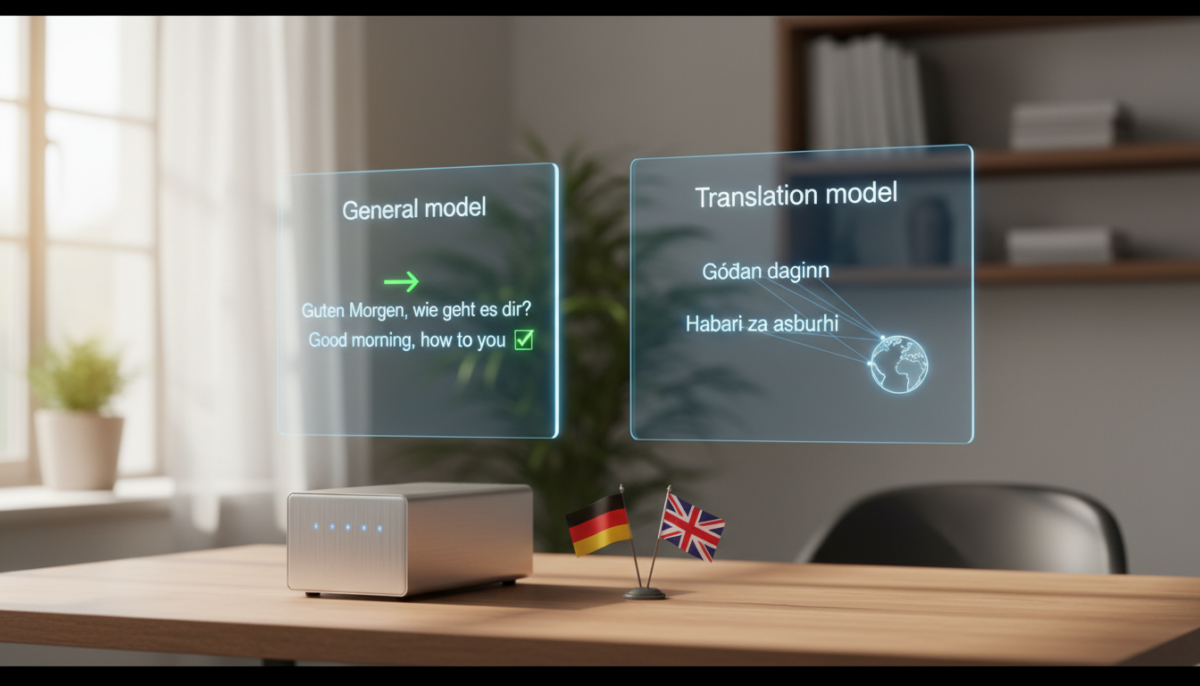
In January 2026, Google released TranslateGemma, a family of open models built only for translation. I already translate a lot with the normal Gemma models, which run locally with Ollama on my Mac Mini M4 Pro. I described that setup in Ollama on macOS. So I wanted to know if a specialised model makes a difference for my use case.
The short answer: for German and English, I have never found a problem with the general models that a translation model would have solved.
What TranslateGemma is
TranslateGemma is based on Gemma 3 and comes in three sizes: 4B for mobile devices, 12B for laptops and 27B for a single large GPU. It supports 55 languages. Google trained it on human and synthetic translations and then fine-tuned it with reinforcement learning on translation quality metrics. According to Google, the 12B model beats the general Gemma 3 27B model on the WMT24++ benchmark. The details are in the technical report.
You do not need a data centre GPU for this. All three sizes, including the 27B model, run on my Mac Mini M4 Pro with Ollama.
The interesting part is where the gains come from. The Decoder reports that the biggest improvements are for languages with little training data: errors for English to Icelandic dropped by more than 30 percent, and English to Swahili improved by about 25 percent.
My experience with German and English
I have used Gemma 2 and Gemma 4 for translations between German and English. The results were good enough that I never felt the need to switch to a specialised model. The text reads naturally, technical terms stay correct, and formatting such as lists or Markdown survives.
This makes sense. German and English are among the best-covered languages in any training data set. A general model has seen so much text in both languages that there is not much left for a translation model to improve. The benchmark gains show up where the general model is weak, and German and English are not one of those cases.
A general model also has a practical advantage: I can ask it to translate and do something else in the same step, for example shorten the text, change the tone or keep certain terms in English. One model for everything is easier to run than a separate model per task.
When a translation model makes sense
- Less common languages: This is where TranslateGemma shows the largest improvements over the general models.
- Small hardware: If a smaller translation model reaches the quality of a larger general one, you save memory and time. This matters on a phone or a small server.
- Large batches: When you translate a lot of text automatically, a model that only translates is more predictable than a chat model that sometimes adds comments or explanations.
Google recommends prompting TranslateGemma as a professional translator who takes cultural nuances into account. Because it was also trained with general instruction data, it still works as a normal chat model.
Conclusion
If you mostly translate between German and English, the Gemma model you already run is probably good enough. I would try TranslateGemma as soon as other languages come into play, especially the less common ones.