

On 20 October 2026, the PHP security team announced a security release for 21 October 2026 at 14:00 UTC (16:00 in Switzerland). It is out now: PHP 8.5.12, 8.4.27, 8.3.36 and 8.2.35 fix two critical vulnerabilities that can allow unauthenticated remote code execution. The community calls them PHP2Shell, tracked as CVE-2026-109618 and CVE-2026-109619. PHP strongly encourages all users to update immediately.
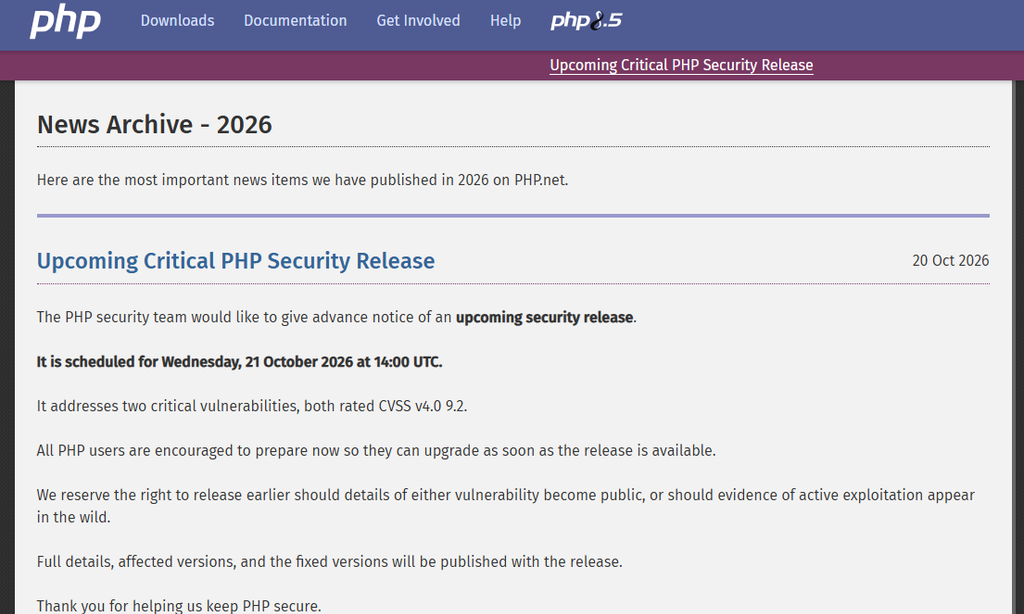
The first announcement was very short on purpose, with no versions and no technical details. Now the details are out. Check which PHP versions you run, and where they come from:
# PHP CLI version
php -v

# The web server can run a different PHP than the CLI,
# so also check phpinfo() or your container image tags.What PHP published
The security advisory says all PHP installations serving web requests are at risk: PHP-FPM, Apache with mod_php, php-cgi, FrankenPHP and LiteSpeed. PHP considers the risk highest for mod_php, where a demonstrated exploit triggers the attack with an unauthenticated request before any application code runs.
- CVE-2026-109618, RCE via OOM corruption (GHSA-w8hw-w9fx-j79w): out-of-memory handling can interrupt PHP while request data is only partially initialised. The cleanup then treats the invalid data as valid.
- CVE-2026-109619, RCE via stale global state (GHSA-6wmf-4rv5-p3rp): request state can survive after its memory was freed, and a later request on the same worker may use it.
- Fixed in: PHP 8.5.12, 8.4.27, 8.3.36 and 8.2.35. Linux distributions and LTS vendors got the patches in advance, so check your vendor’s packages too.
- PHP 8.1 and older: no official releases. PHP provides minimal source backports for 7.4, 8.0 and 8.1. Otherwise ask your LTS vendor or upgrade.
- remirepo:
rpms.remirepo.netwill not have updates today. PHP recommends switching to distribution packages or building from source.
If you cannot update right away
PHP lists workarounds that reduce exposure but do not make an installation safe. Set them where applications cannot override them (php.ini, FPM pool or server configuration, not ini_set() or .user.ini) and restart every worker:
- CVE-2026-109618:
memory_limit=-1, for example withphp_admin_value. A lowpost_max_size(8M, or 32M if you need uploads) withupload_max_filesizebelow it, plus request limits on the web server or proxy. Use a container or cgroup limit, notRLIMIT_ASorRLIMIT_DATA. - CVE-2026-109619:
session.upload_progress.enabled=0, and on PHP 8.5 alsofatal_error_backtraces=0. Remove invalid or deprecated per-request settings that emit diagnostics, and fix fatal errors and timeouts an attacker can trigger.
CERT-EU: consider taking sites offline
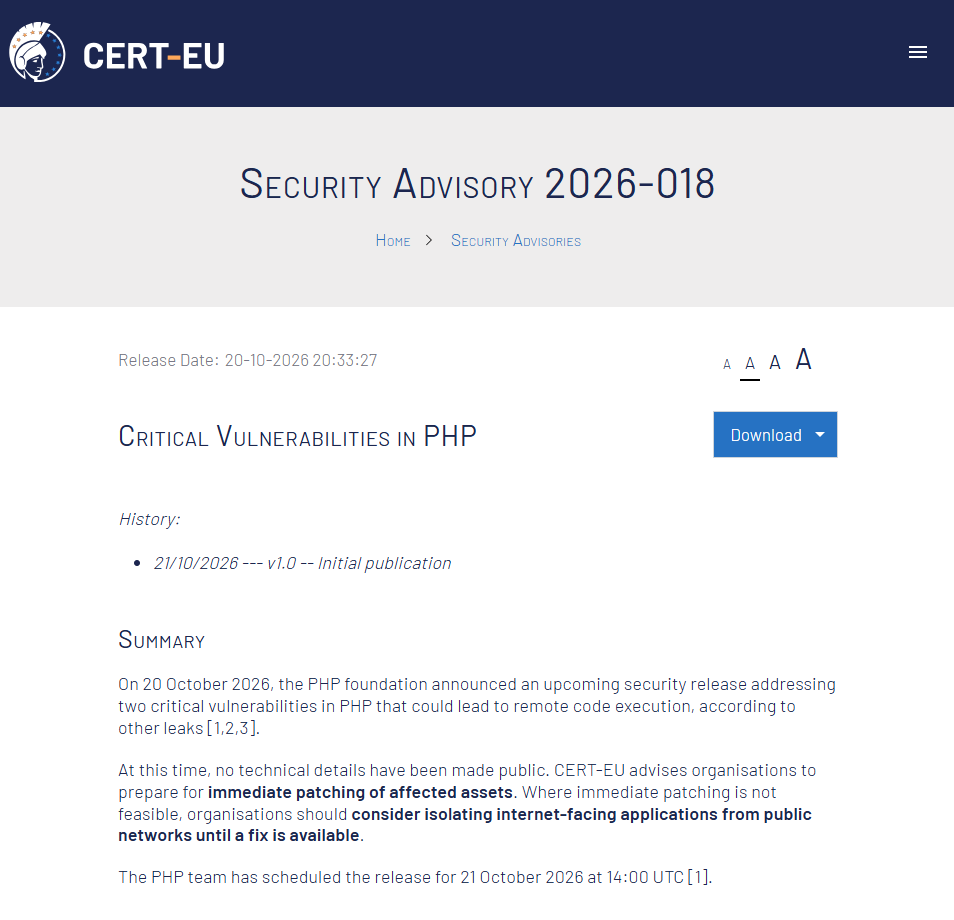
Before the release, CERT-EU, the cybersecurity service of the EU institutions, published Security Advisory 2026-018. It strongly recommends identifying PHP-based applications and patching them immediately. Where that is not possible, organisations should consider isolating internet-facing applications from public networks until a fix is available. In other words: take the website offline. That was an unusually clear recommendation for a vulnerability without any public details at the time.
What I expect next
I think this won’t be the last one. In many products I’ve seen that once something serious is found, more people get curious and dig in the same corner: old reports get a second look and new ones turn up. The PHP Foundation already sees this. In its post about this release it writes that the security team “receives far more reports than before”, partly because of AI-assisted research. At the same time, Reuters reports that the foundation has just one full-time staff member and 14 mostly part-time contractors, and its director calls PHP “incredibly under-funded”. I’ll be curious to see if PHP is heading into a streak of new issues. If your business runs on PHP, sponsoring the foundation is worth a look.